

Almost every baby goes through it, and almost every parent second-guesses it. Baby teething starts earlier for some infants than others, the symptoms overlap with ordinary illness, and the shelves are full of products that range from genuinely useful to actively unsafe. This guide covers what to expect, what actually helps, and what paediatric regulators say to keep away from.
What is baby teething?
Teething is the process of the first set of teeth pushing through the gums. The tooth has to break through gum tissue to reach the surface, which is why the gum above an erupting tooth looks swollen and reddened and why babies want to chew on everything in reach. Counter-pressure on the gum feels good, which is the entire principle behind a teether.
Each individual tooth causes discomfort for roughly three to eight days around the time it breaks through. Teething is not one long continuous ordeal from four months to three years, even though the overall eruption period spans that range.
When do baby teeth come in?
The order is far more consistent than the timing. Most babies get the lower front teeth first and the back molars last. The month ranges below are typical, not a schedule to worry against.
- 3 to 10 months – lower central incisors (the two bottom front teeth)
- 8 to 12 months – upper central incisors
- 9 to 13 months – upper lateral incisors
- 10 to 16 months – lower lateral incisors
- 13 to 19 months – upper first molars
- 14 to 18 months – lower first molars
- 16 to 22 months – upper canines
- 17 to 23 months – lower canines
- 23 to 31 months – lower second molars
- 25 to 33 months – upper second molars
A baby who has no teeth at ten months is usually still well within normal range. Late eruption on its own, with no other symptoms, is rarely a problem worth acting on.
Which symptoms are actually teething?
Teething gets blamed for a lot it does not cause. The symptoms genuinely associated with it are fairly narrow:
- Swollen, reddened or tender gums
- Heavy drooling, and sometimes a mild rash on the chin or around the mouth from constant wetness
- A strong urge to chew and bite on things
- Mild irritability and disrupted sleep
- Reduced appetite, or fussiness at the breast or bottle
- Rubbing the cheek or pulling at the ear on the same side as an erupting tooth
- A slight cough from the extra saliva
What teething does not cause
This part matters more than the list above. Teething may push body temperature very slightly up, but it does not cause a true fever. It also does not cause diarrhoea, vomiting, or a persistent cough. If your baby has any of those, the reasonable assumption is that something else is going on and it deserves a look, rather than being written off as teething.
How to soothe sore gums safely
The methods with the best safety record are also the simplest ones.
- Massage the gum. With a clean finger, apply firm, gentle pressure to the sore area. This is the single most effective thing most parents can do, and it costs nothing.
- Offer a firm teether. A solid rubber or food-grade silicone teether gives the counter-pressure the baby is looking for. Firm and one-piece is the goal, not liquid-filled.
- Chill it, do not freeze it. A cool teether soothes; a rock-hard frozen one can bruise or damage a developing gum. Refrigerate it, and skip the freezer.
- Wipe the drool. Patting the chin dry through the day prevents most teething rashes before they start.
Our baby teethers range is built around that principle: one-piece food-grade silicone with nothing inside to leak. The Baby Teething Chick Toy suits babies who can already grip, and the silicone teething mitten straps to the hand for younger infants who have not worked out how to hold things yet.
What to keep away from
Several widely sold teething products carry warnings from drug regulators including the US Food and Drug Administration:
- Benzocaine gels (sold as Anbesol, Orajel, Cepacol and similar). These can cause methemoglobinemia, a rare but potentially fatal condition that reduces the blood’s ability to carry oxygen. The FDA advises against using them for teething in infants and young children.
- Topical lidocaine. A prescription medicine never intended for teething. If swallowed, it has been linked to seizures, severe brain injury and heart problems in infants.
- Homeopathic teething tablets and gels. The FDA has warned that these carry real risks with little or no demonstrated benefit.
- Teething necklaces, bracelets and amber jewellery. These have been linked to strangulation and choking deaths. Nothing worn around a baby’s neck is worth the risk.
- Frozen-solid teethers. Too hard for a soft, inflamed gum. Cool, not frozen.
How to choose a baby teething toy
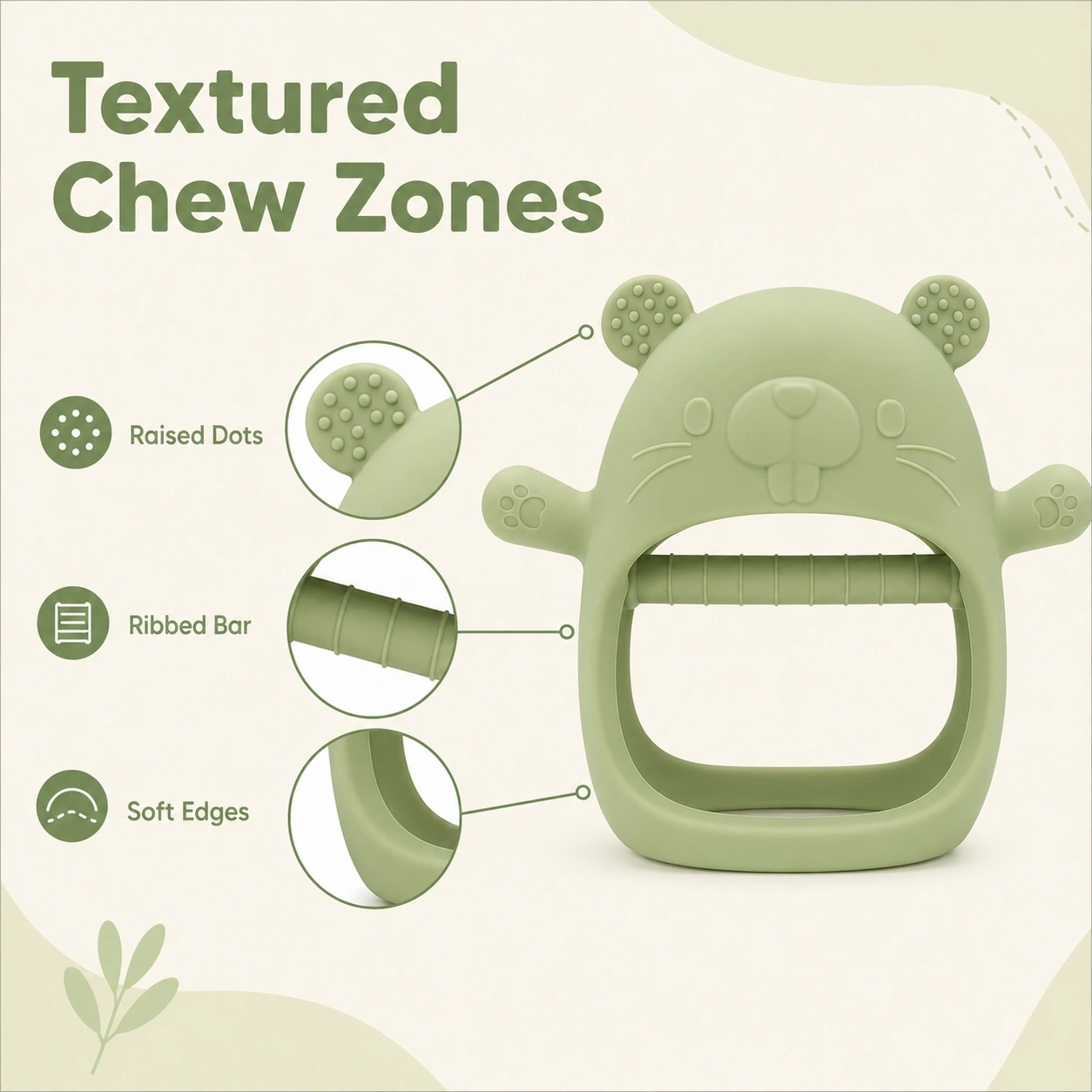
- One piece, no filling. Liquid-filled teethers can split and leak; multi-part toys can come apart into choking hazards.
- Food-grade silicone or firm rubber. Both are soft enough for gums and durable enough to survive months of chewing.
- Bigger than the baby’s mouth. Anything that fits entirely inside the mouth is a choking risk.
- Easy to hold, or attached. Younger babies drop everything. A mitten or a wide loop solves the problem better than repeatedly picking things off the floor.
- Washable. A teether lives in a mouth. It needs to survive daily cleaning.
Keeping a teether clean
Wash with warm water and mild soap after each use, rinse thoroughly, and let it air-dry completely before storing. Check regularly for splits, tears or thinning spots, especially once teeth have actually broken through, and replace a teether that has started to break down.
When to call your doctor
Speak to your paediatrician if your baby has a genuine fever, has diarrhoea or is vomiting, persistently refuses to feed, seems to be in pain beyond ordinary fussiness, or shows signs of an ear infection. These are not teething, and teething should never be the reason a real symptom goes unexamined.
This article is general information, not medical advice. Every baby is different – your paediatrician knows yours. Sources: US Food and Drug Administration, “Safely Soothing Teething Pain in Infants and Children”; Children’s Hospital Los Angeles, “A Parent’s Guide to Teething”.